Problem Space
Problem area
Healthcare Documentation - Digital Transformation for Gynaecology and Obstetrics
Problem statement
“ How might we create a digital system to help doctors ease their consulting experience by organizing and prioritizing relevant information while treating pregnant woman? ”
Smara- Antenatal care made easy
Smara is on a quest to solve a problem in the area of obstetrics and gynaecology, a specialized field of medicine which deals with women going through pregnancy and childbirth. Our goal is to help create a seamless experience for obstetrician - gynecologists to consult and treat women going through pregnancy.
As a progressive step to achieve our goal - designing a digital maternity record as a system that will help doctors while treating pregnant women. Among the many benefits that we envision for the doctor, the most important will be to present the relevant patient information in an easily accessible and usable manner while providing prenatal care.
Overview
My Role
UX Designer
No-code
Prototyping
Design space
Understanding the problem area and deep dive into the problem space. Validate problem statement.
Step 1 - Discovery
Understand the current system and pain points. Conduct user research(qualitative research) to gather insights. Competitor analysis.
Step 2 - Audit & user research
Plan for shaping the solution space. Mapping gathered insights to the solution.
Step 3- Design Strategy
Translating the envisioned solution digitally. Co-create with doctor. Iterate to deliver clickable prototype. No-code for the MVP
Step 4 - Wireframing & prototyping
Test the product with doctors and collect feedback.
Step 5 - Usability testing
Discovery
Understanding the problem from doctor’s POV was very important. Usually what happens is the digital solutions are crafted from organizational POV especially in the field like medicine. And thus I wanted to understand what doctors think; what he/she expected to see in daily life.
Also, I invested sometime to desk research and gone through pre-recorded interviews too. Thanks to Google and Youtube !!
Domain Deep dive
I wanted to be very keen on the burning problems that must be solved for the gynaecologist and obstetrics. And thus, I tried to cover all of them.
It is important to maintain relevant patient’s medical records throughout pregnancy
The decision maker is not able to access critical information directly - many dependencies
Documents are scattered and not organized
A structured way of maintaining records will help in better decision making - especially in high risk pregnancies
Existing EMR systems are complex to use and time taking
Existing digital documentation is not cutomised for obstetrics and gynaecology
Validated problems list
Person ✅ NOT a PERSONA for whom I am going to solve a problem
Now, for further part I wanted to have a concrete understanding of the person for whom I am going to solve a problem. Medicine is a field where it is better to have a person having pain points; instead of just going for the generalised persona
If I am able to do it for one person I will be able to do it for more
Dr. Gowthami, Age - 34, Chennai
Current system for treating pregnant women
Current system for treating pregnant women
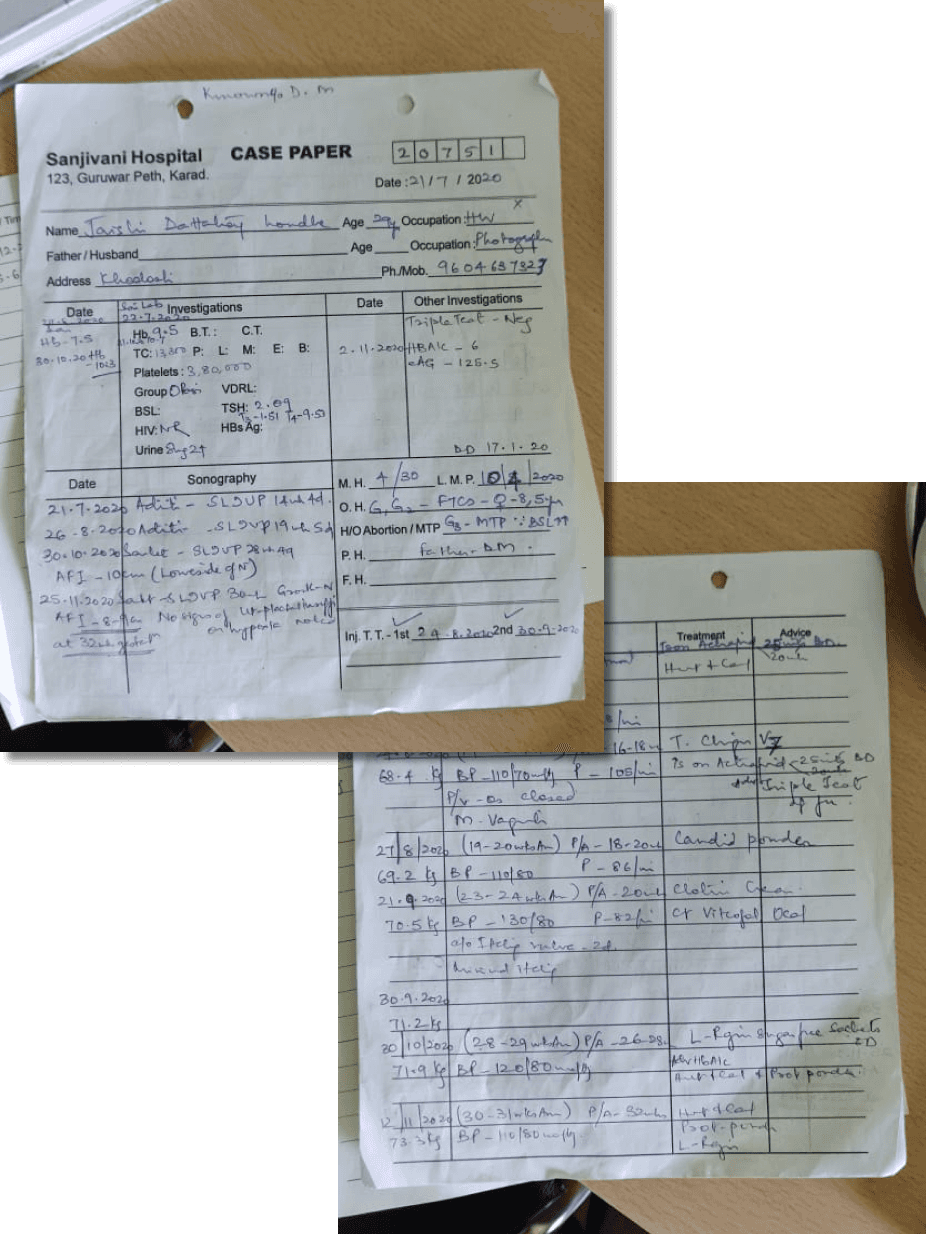
I wanted a person who is willing to adopt the digital technology and here I came across Dr.Gowthami. She had an existing EMR but it was not helping her. It was not customized according to her needs. And thus she herself came up with the physical maternity card for antenatal care. That way it was easy for her to treat the patients.
In spite of having this in a place she was facing issues. And I tried to focus on the most important pain points from the list of many. And these pain points are;
>Switching between two systems - resulting in time delays & operational inefficiencies
>Redundancy in information gathering
>Space constraint on physical card
>Patient Loosing the card
>Using the physical card as the only means of documentation for entire antenatal management
>Current EMR is not customized for documenting information needed for antenatal care
-Who treats 10-15 pregnant ladies in a day
-Has 4+ years of experience
-Has an independent medical practice
-Willing to adopt digital technology
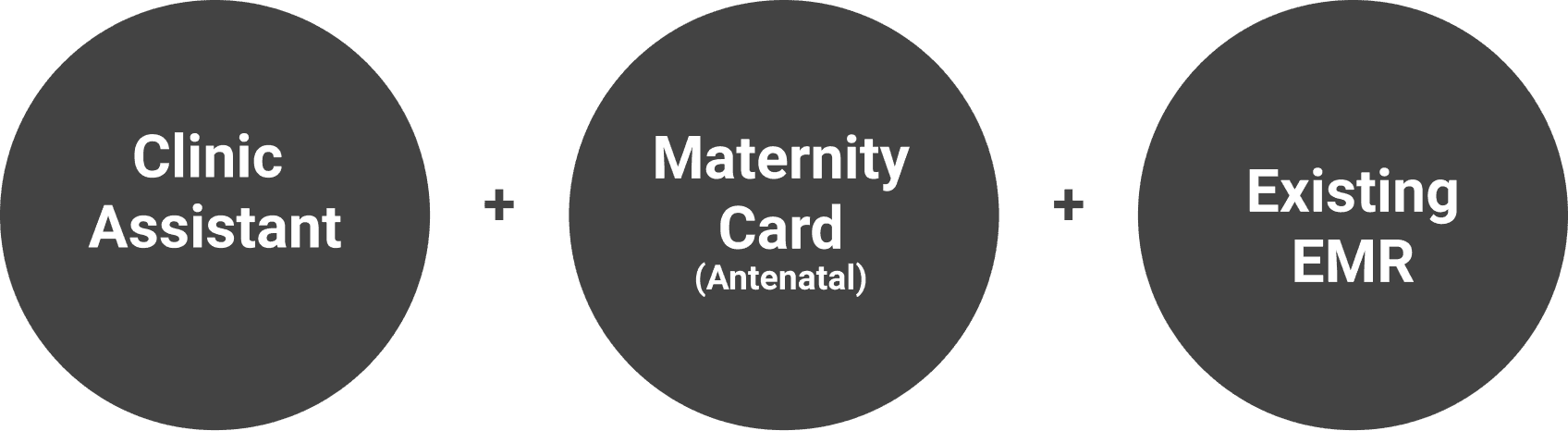
Let’s make this watertight
Before diving into the solution space, I recognized the importance of validation from doctors. To ensure thorough research, I decided to conduct interviews with gynecologists in their own settings. It was crucial to understand their perspectives and gain insights into their daily routines.
Given the unique context of the Indian healthcare system and the specific patient population they handle, relying on international solutions as references was not feasible. By conducting one-on-one interviews, both in-person and digitally, I aimed to gather valuable insights and verify my conclusions while understanding the behaviors and thoughts of other gynecologists.
And it was a right decision to go by a person as I saw the commonality in the data points that all of them shared with me.
Insights
> Doctors find data entry in digital systems time-consuming
> Ease and speed of use for all care team members is lacking in existing digital systems, making training support staff challenging
> A unified platform that integrates the entire workflow in doctor-patient interactions is preferable over using multiple solutions for different problems
> Custom solutions tailored to meet the specific needs and preferences of doctors are required
Solution space
Unified system - single source of truth for all relevant patient information
Quick access to patient records from anywhere, anytime, on any device
Customized SOAP notes as a best practice to document patient information in a structured and organized way, for antenatal care
Visualization of dynamic patient data to help in making customized treatment plans based on risk factors
Visual cues in the form of prefilled data to reduce data entry time
Easy Learning Curve for all users
Design Strategy
> Cloud based Antenatal Care Web Application - Access to patient information from anywhere, anytime, any device
> SOAP Notes Based data entry (existing best practice) customized to meet the needs of the obstetrician gynaecologist - Co-Creation with doctor
> Reduced dependency on patients to maintain pregnancy related information
> A system that can help monitor, recall and treat both low and high risk pregnancies
> Relevant and Organized information made available to the decision makers - the doctors
No-code development
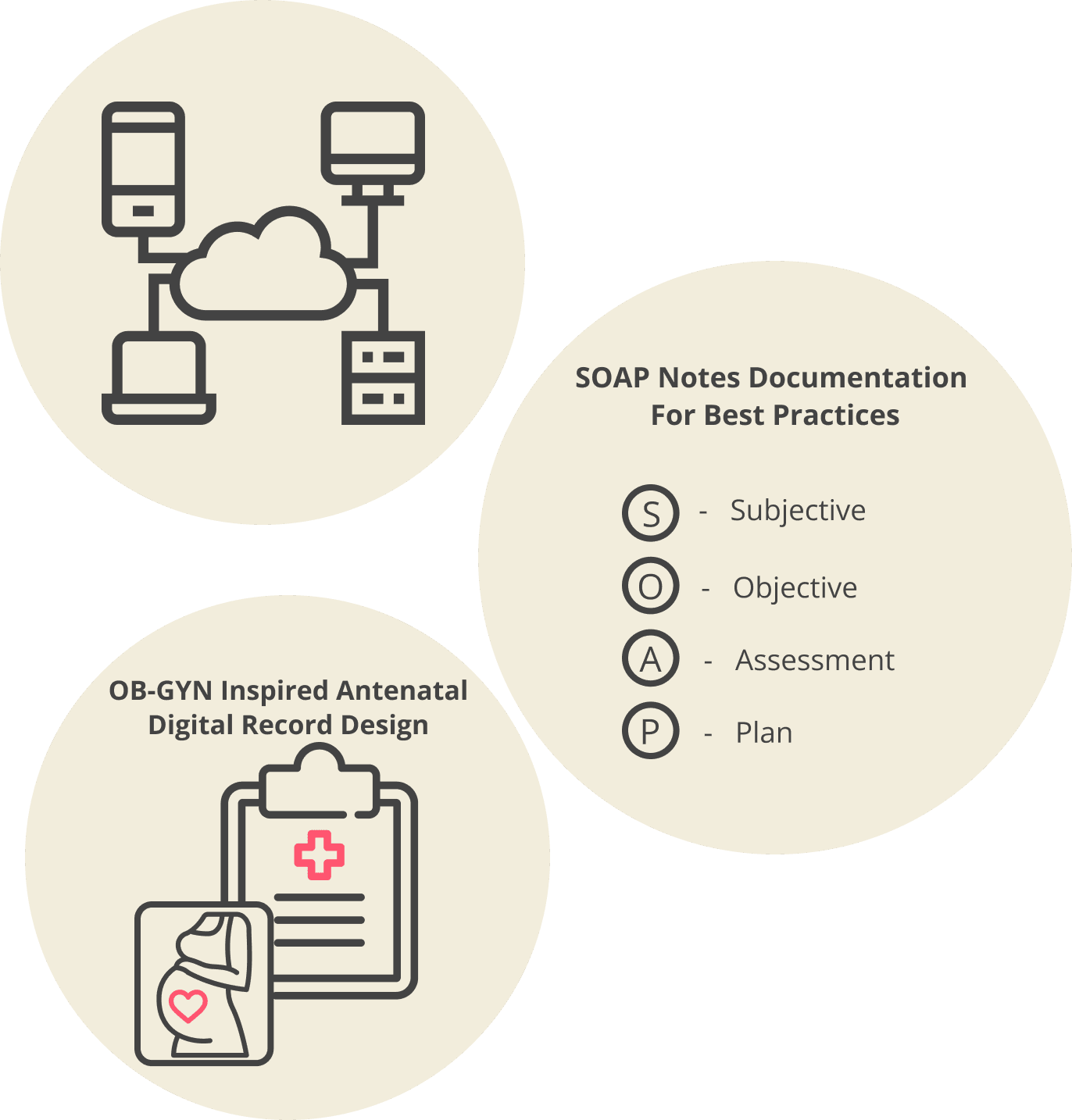
To facilitate collaboration with the doctor and test the problem-solution fit in real-time, I opted for a no-code development approach. Notion proved to be a powerful tool, enabling the creation of a user-friendly no-code experience that eased the learning curve for doctors transitioning from physical cards to the digital system.
Dr. Gowthami has already recognized the value of the solution and willingly contributed her time to improve it further. This feedback and collaboration drive my motivation to refine the system to an even higher standard.
Customer validation
“ All the information presented is wonderful. It will not only benefit me but all doctors who provide antenatal care. Really like the ease of using one system vs multiple systems. I will be able to manage both low and high risk pregnancies. One system for all pregnant women. Can I start using this now ? ”
Value creation & delivery
Value
Delivery
Cloud Based System Web Application
Access organized and relevant patient information from anywhere, anytime, any device
Visual Cues - Ob Gyn Library
Reduced effort and time needed to enter patient data
Patient Information & Reports accessible to doctor after entering once
Reduced dependency on patients and physical records to access relevant patient data
Predefined formulas for computing data
Improved interactions for computing patient data
Trend Graphs to aid in decision making
Meaningful data connection to help in decision making
Integrating existing workflows into product
In line with doctor’s current consultation pattern
Market size & finance
Market size
There are 37,000 registered Obstetrician Gynaecologist in India
KPI
• Doctor’s experience
• Patient’s experience
• Doctor Subscriptions
Pricing - Monthly/Yearly Subscription Model
• ₹ 500 per month (monthly) / ₹ 400 per month (yearly)
• Monthly revenue for 2% of customers - 740 doctors - ₹ 3,70,000
Expenditure one time
• Development - ₹ 15,00,000
• Digital Marketing Setup - ₹ 50,000
• Total ₹ 15,50,000 one time cost
Expenditure - monthly recurring cost
• Server Cost - ₹ 10,000 per month
• Maintenance - ₹ 1,00,000 per month
• Support - ₹ 20,000 per month
• Digital Marketing - ₹ 50,000 per month
• ₹ 1,80,000 cost per month
Future scoping
In conclusion, my ultimate aim is to inspire future generations of obstetricians and gynecologists to embrace and adopt newer technologies in order to enhance the provision of efficient antenatal care. By designing user-friendly digital solutions tailored to their needs and collaborating closely with doctors, we can create a positive impact on the healthcare industry.
Smara- Antenatal care made easy
Overview
Smara is on a quest to solve a problem in the area of obstetrics and gynaecology, a specialized field of medicine which deals with women going through pregnancy and childbirth. Our goal is to help create a seamless experience for obstetrician - gynecologists to consult and treat women going through pregnancy.
As a progressive step to achieve our goal - designing a digital maternity record as a system that will help doctors while treating pregnant women. Among the many benefits that we envision for the doctor, the most important will be to present the relevant patient information in an easily accessible and usable manner while providing prenatal care.
My Role -
UX Designer,
No-code,
Prototyping
Problem Space
Problem area
Healthcare Documentation - Digital Transformation for Gynaecology and Obstetrics
Problem statement
“ How might we create a digital system to help doctors ease their consulting experience by organizing and prioritizing relevant information while treating pregnant woman? ”
Design space
Step 1 - Discovery
Understanding the problem area and deep dive into the problem space. Validate problem statement.
Step 2 - Audit & user research
Understand the current system and pain points. Conduct user research(qualitative research) to gather insights. Competitor analysis.
Step 3- Design Strategy
Plan for shaping the solution space. Mapping gathered insights to the solution.
Step 4 - Wireframing & prototyping
Translating the envisioned solution digitally. Co-create with doctor. Iterate to deliver clickable prototype. No-code for the MVP
Test the product with doctors and collect feedback.
Step 5 - Usability testing
Discovery
Understanding the problem from doctor’s POV was very important. Usually what happens is the digital solutions are crafted from organizational POV especially in the field like medicine. And thus I wanted to understand what doctors think; what he/she expected to see in daily life.
Also, I invested sometime to desk research and gone through pre-recorded interviews too. Thanks to Google and Youtube !!
Domain Deep dive
I wanted to be very keen on the burning problems that must be solved for the gynaecologist and obstetrics. And thus, I tried to cover all of them.
It is important to maintain relevant patient’s medical records throughout pregnancy
The decision maker is not able to access critical information directly - many dependencies
Documents are scattered and not organized
A structured way of maintaining records will help in better decision making - especially in high risk pregnancies
Existing EMR systems are complex to use and time taking
Existing digital documentation is not cutomised for obstetrics and gynaecology
Validated problems list

Person ✅ NOT a PERSONA for whom I am going to solve a problem
Now, for further part I wanted to have a concrete understanding of the person for whom I am going to solve a problem. Medicine is a field where it is better to have a person having pain points; instead of just going for the generalised persona
If I am able to do it for one person I will be able to do it for more
Current system for treating pregnant women
In spite of having this in a place she was facing issues. And I tried to focus on the most important pain points from the list of many. And these pain points are;
>Switching between two systems - resulting in time delays & operational inefficiencies
>Redundancy in information gathering
>Space constraint on physical card
>Patient Loosing the card
>Using the physical card as the only means of documentation for entire antenatal management
>Current EMR is not customized for documenting information needed for antenatal care
Dr. Gowthami, Age - 34, Chennai
-Who treats 10-15 pregnant ladies in a day
-Has 4+ years of experience
-Has an independent medical practice
-Willing to adopt digital technology
Current system for treating pregnant women
I wanted a person who is willing to adopt the digital technology and here I came across Dr.Gowthami. She had an existing EMR but it was not helping her. It was not customized according to her needs. And thus she herself came up with the physical maternity card for antenatal care. That way it was easy for her to treat the patients.
Let’s make this watertight
Before diving into the solution space, I recognized the importance of validation from doctors. To ensure thorough research, I decided to conduct interviews with gynecologists in their own settings. It was crucial to understand their perspectives and gain insights into their daily routines.
Given the unique context of the Indian healthcare system and the specific patient population they handle, relying on international solutions as references was not feasible. By conducting one-on-one interviews, both in-person and digitally, I aimed to gather valuable insights and verify my conclusions while understanding the behaviors and thoughts of other gynecologists.
And it was a right decision to go by a person as I saw the commonality in the data points that all of them shared with me.
Insights
-Doctors find data entry in digital systems time-consuming
-Ease and speed of use for all care team members is lacking in existing digital systems, making training support staff challenging
-A unified platform that integrates the entire workflow in doctor-patient interactions is preferable over using multiple solutions for different problems
-Custom solutions tailored to meet the specific needs and preferences of doctors are required
Solution space
Unified system - single source of truth for all relevant patient information
Quick access to patient records from anywhere, anytime, on any device
Customized SOAP notes as a best practice to document patient information in a structured and organized way, for antenatal care
Visualization of dynamic patient data to help in making customized treatment plans based on risk factors
Visual cues in the form of prefilled data to reduce data entry time
Easy Learning Curve for all users
Design Strategy
Cloud based Antenatal Care Web Application - Access to patient information from anywhere, anytime, any device
SOAP Notes Based data entry (existing best practice) customized to meet the needs of the obstetrician gynaecologist - Co-Creation with doctor
Reduced dependency on patients to maintain pregnancy related information
A system that can help monitor, recall and treat both low and high risk pregnancies
Relevant and Organized information made available to the decision makers - the doctors
No-code development
To facilitate collaboration with the doctor and test the problem-solution fit in real-time, I opted for a no-code development approach. Notion proved to be a powerful tool, enabling the creation of a user-friendly no-code experience that eased the learning curve for doctors transitioning from physical cards to the digital system.
Dr. Gowthami has already recognized the value of the solution and willingly contributed her time to improve it further. This feedback and collaboration drive my motivation to refine the system to an even higher standard.
Customer validation
“ All the information presented is wonderful. It will not only benefit me but all doctors who provide antenatal care. Really like the ease of using one system vs multiple systems. I will be able to manage both low and high risk pregnancies. One system for all pregnant women. Can I start using this now ? ”
Value delivery
Cloud Based System Web Application
Visual Cues - Ob Gyn Library
Patient Information & Reports accessible to doctor after entering once
Predefined formulas for computing data
Trend Graphs to aid in decision making
Integrating existing workflows into product
Market size & finance
Market size
There are 37,000 registered Obstetrician Gynaecologist in India
KPI
• Doctor’s experience
• Patient’s experience
• Doctor Subscriptions
Pricing - Monthly/Yearly Subscription Model
• ₹ 500 per month (monthly) / ₹ 400 per month (yearly)
• Monthly revenue for 2% of customers - 740 doctors - ₹ 3,70,000
Expenditure - monthly recurring cost
• Server Cost - ₹ 10,000 per month
• Maintenance - ₹ 1,00,000 per month
• Support - ₹ 20,000 per month
• Digital Marketing - ₹ 50,000 per month
• ₹ 1,80,000 cost per month
Expenditure one time
• Development - ₹ 15,00,000
• Digital Marketing Setup - ₹ 50,000
• Total ₹ 15,50,000 one time cost
Future scoping
In conclusion, my ultimate aim is to inspire future generations of obstetricians and gynecologists to embrace and adopt newer technologies in order to enhance the provision of efficient antenatal care. By designing user-friendly digital solutions tailored to their needs and collaborating closely with doctors, we can create a positive impact on the healthcare industry.